Showing posts with label Tools. Show all posts
Showing posts with label Tools. Show all posts
Wednesday, August 3, 2016
Fighting the Gorn
In a classic episode of the original Star Trek series, Captain Kirk has to fight the captain of the Gorn ship in one-on-one combat using only what he can find on a deserted planet. The Gorn, while slower than humans, were much stronger, so Kirk had no hope of defeating him hand-to-claw. What he did was build a cannon. Mythbusters did a show that proved that it wasn't possible using the ingredients shown. But that is not the last word! Using an ingredient that they would not have shown on television in the 1960s, these guys show that it is possible:
This isn't really about an almost 50 year old TV episode, though. The key point here is that just a tiny bit of knowledge can mean the difference between success and failure.

Thursday, July 21, 2016
Finding Your Way
Tiny Yellow Teardrop has a good article on why you shouldn't rely exclusively on your GPS. She recommends instead to use:
Those are all fine ideas. Another service to use is MapQuest. They generally give you a choice of routes (frequently they are: quickest, shortest, or simplest). And if you aren't satisfied with any of those, you can generally pick a point in the middle of the route and move it over and MapQuest will snap to an alternate route. And once you have settled on a route, you can print out directions, including both route map and optional turn-by-turn maps, or you can send yourself a text.
But you know what I really like to do when I am traveling a route to a destination that I frequent (and I'm not in any hurry)? Turn my GPS off and deliberately make a wrong turn and then see if I can find my way back to my route, without making a U turn. (If at some point I decide I'm truly lost, I turn my GPS back on.) I see a lot of interesting things that way.
- Google Maps and Google Earth
- Paper Maps
- Ask the locals
Those are all fine ideas. Another service to use is MapQuest. They generally give you a choice of routes (frequently they are: quickest, shortest, or simplest). And if you aren't satisfied with any of those, you can generally pick a point in the middle of the route and move it over and MapQuest will snap to an alternate route. And once you have settled on a route, you can print out directions, including both route map and optional turn-by-turn maps, or you can send yourself a text.
But you know what I really like to do when I am traveling a route to a destination that I frequent (and I'm not in any hurry)? Turn my GPS off and deliberately make a wrong turn and then see if I can find my way back to my route, without making a U turn. (If at some point I decide I'm truly lost, I turn my GPS back on.) I see a lot of interesting things that way.
Friday, January 15, 2016
Hot Stuff....
You may have seen people collecting aluminum cans to recycle, but probably not like this:

Mobile Foundry for Recycling Aluminum. They use the molten aluminum to cast decorative but useful objects like chairs.
Mobile Foundry for Recycling Aluminum. They use the molten aluminum to cast decorative but useful objects like chairs.
Wednesday, July 15, 2015
Careful Without That Ax, Eugene
Need to cut some wood but don't have an ax or saw? If you have a knife, you can use a technique called batoning:
You do have to be careful, though, or you will break your knife; and if there is another way to split the wood, you want to use that, because no matter how careful you are, you are still making it duller.
You do have to be careful, though, or you will break your knife; and if there is another way to split the wood, you want to use that, because no matter how careful you are, you are still making it duller.
Thursday, July 2, 2015
If I Could Keep Time In A Bottle...


Wednesday, July 1, 2015
The Park Grill at Home

Monday, June 29, 2015
Drying in the Sun

Sunday, June 28, 2015
B.O.M.B. Making 101
No, this isn't a recipe from The Anarchist's Cookbook, it's a variation on the Bug Out Bag: the Bug Out Medical Bag. A souped-up version of a first-aid kit, these are more commonly known as gunshot wound or gunshot trauma kits. Survivopedia has instructions on how to assemble your own for less than $100. The main components:
- Tourniquet
- Compression Bandages
- Suture Kit
- Splint/Sprain Wrap
- Blood Clotting Agents
- Miscellaneous
Saturday, June 27, 2015
Credit Card Survival....

 No, this has nothing to do with financial advice.... People are taking notice of SurvCo's new Credit Card Ax. While it is fairly unique to have something that can be turned into a hatchet be the size of a credit card, there are too many multi-tools to mention that fit that dimension. Indeed, you could easily end up needing a second wallet if you got them all!
 ReadyMan has an interesting break-apart version (shown on the right) which they are giving away for "free", plus shipping and handling. They do have a video showing you how to use it they send a link to you when you order. Of course, they do try to get you to sign up for a monthly membership in their organization.
 One of the oldest and probably one of the best values is the 11-function one on the left. I've had it so long I've forgotten where I put it! It's hardly worth buying by itself, the shipping is more than the cost of the item. My guess is any patent protections have run out, that's why there are so many inexpensive copies.
To my eyes, one of the sleekest of the genre is the Wallet Ninja. Having a Phillips screwdriver is unusual in itself for a credit-card survival tool, but I think the function I would use most is the box cutter/letter opener; that's what I wish I had on my Gerber shard. Interestingly, while I've never tried them yet, KnifeCenter lists 30 items in this category (although a number only differ by color), some of them quite pricey.

Perhaps the most whimsical of the entire bunch is the PocketMonkey. At only 1 ounce and 1 mm thick, I don't expect it to be the most durable, but it might just be the most convenient to carry around -- they even say it is TSA compliant!


Monday, June 22, 2015
13 Essentials for Survival
ScottishGent at The Survivalist Blog has updated the concept of 10 essential survival items to 13 categories of items to carry everyday or put in a get-home bag.
- Navigation
- Sun protection
- Insulation
- Illumination
- First-aid supplies
- Fire
- Repair kit and tools
- Nutrition
- Hydration
- Emergency shelter
- Signaling
- Personal Protective Equipment
- Self-Defense / Weapons
Friday, June 19, 2015
A Pen is Mightier than A Sword...
Especially when it is a gun....

Survivopedia has instructions for turning pens into guns: either spring-loaded BB guns or rubber-band dart guns.
Now, I don't think they're legal where I live, but it's nice to have the knowledge if I ever end up somewhere the police aren't around for protection.
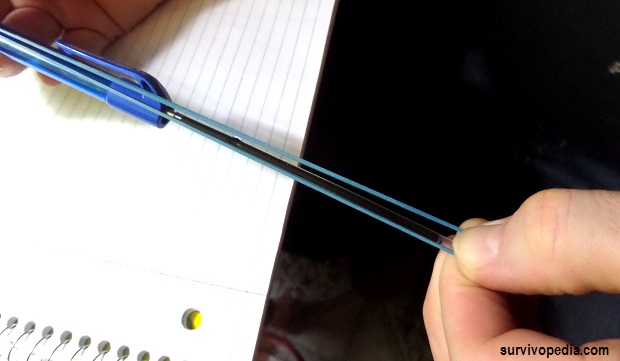
Survivopedia has instructions for turning pens into guns: either spring-loaded BB guns or rubber-band dart guns.
Now, I don't think they're legal where I live, but it's nice to have the knowledge if I ever end up somewhere the police aren't around for protection.
Thursday, June 18, 2015
Keeping It Fresh....
Organic Authority has 8 Food Storage Options for Your Backyard Party. I have and love the Pyrex, although I rarely use it for food storage, more for cooking, but it is nice to just put leftovers away without taking them out of the pan sometimes. I have a few of an older style Anchor Hawking storage set, and they work great. The rest I haven't tried, but they do look interesting, albeit a bit pricey.
Wednesday, June 17, 2015
Hot, Hot, Hot...
M. D. Creekmore at The Survivalist Blog has 6 options for cooking without utilities. While it is by no means comprehensive, it does give a nice range of possibilities.
Monday, June 15, 2015
Critical Points for Off-Grid Solar
Patty Hahne at Preppers Illustrated has some important things to consider in designing an off-grid solar power system. Anything but the smallest flashlight-battery system will not be plug-and-play, and if you are expecting to just take it out of the box and have it work perfectly, you will be disappointed.
Sunday, June 14, 2015
3 Crucial Steps for Digging Water Wells
While I have no plans in the immediate future for digging a well for water, this article by Chris Black on Survivopedia looks like an extremely useful reference if I ever do need to.

Friday, June 12, 2015
Dig This...
The guy is speaking in Russian (I believe), but it doesn't matter, the video on his Facebook page speaks for itself. He's invented a cool tool to turn soil using bicycle handlebars. The only unfortunate thing is it looks like he is demonstrating it on soil that has already been worked; I'd really want to see how it does on virgin soil.
Monday, June 8, 2015
Marking Contours with a Simple A-Frame Level

Sunday, January 25, 2015
A Cardboard What?
Izhar Gafni made a bicycle almost entirely out of cardboard:
 Inhabitat has the orginal story, but The Flying Tortoise put the article together in a much friendlier way to read.
Wednesday, December 3, 2014
Tales of an Exiled Citizen #9: Light My Fire
Beginning of story
Previous part
No Outsider will ever be able to fully understand just how much terror Fire puts into the heart of a Citizen. Only Exile invokes more fear, because that necessarily is faced alone -- indeed, if they have several people to Exile, they will wait a couple weeks in between each just to ensure that. At the most basic level, certainly, everyone can understand not wanting to get burned, it's a universally unpleasant experience. It is much more than that, though. People living in closely-built villages have some idea of the existential threat, that a fire in one building can catch on to the next until nothing is left. Even with that, though, they do not have the same experience as a Citizen, for they at least have the reassurance that they can rebuild their village. Were the City to be destroyed, it would be virtually impossible to rebuild. Citizens know enough to maintain it, but they depend on the systems already being in place to do so. If they had to start over from scratch, they would have no idea where to begin.
Even the fear of catastrophic fires is something that most Outsiders can relate to, if not fully. What few can ever grasp, is that even the routine use of fire represents a danger to Citizens. With the Dome sealing them off from the outside world, burning too much consumes the air and makes it hard to breathe. One way they make sure that doesn't happen is only burning what was produced within the Dome, in the process of being grown it restores the air. They do monitor carefully to make sure that the balance is maintained and neither too much nor too little is burned.
This fear of Fire is deeply designed in to the City. Unlike many Outside buildings, flammable materials like wood are rarely used for construction, and they're avoided for most other uses unless truly necessary. If they can avoid using a flame for anything, they do, and if they can't, they do their best to keep it contained. While things like candles are a luxury on the Outside, they are absolutely forbidden in the City; had I tried to sell candles instead of Beans, I would have been reported by the first person I offered it to and immediately exiled.
There was an interesting consequence to fire being so tightly controlled in the City: whenever a Citizen did need it, it was available at the touch of a button. As hard as it is for an Outsider, who has learned to make fires from childhood, to comprehend, a Citizen has no clue how to make a fire other than by pressing a button. Now back in the Crazy Age, it was a little different. They did have push-button devices for creating fires they called "lighters", but they produced an open flame that would have scared the pants off a Citizen. They also had miniature fire sticks like an Outsider might use, but these (which they called "matches") had an almost magical coating whereby you only had to rub them once lightly and they burst into flames.
I, however, had a unique problem. Once I learned that the Beans needed to be roasted to be fully effective, I had to figure out a way to make fire. The first thing I thought of was to try to use one of the City's systems, but those all used something called "electricity", which is kind of like a captured lightning bolt. I wasn't going to have that anywhere near the Shelter, so I needed another option. That's when I secretly researched all the different ways they made fire in the Crazy Age. Lighters and matches were long gone, of course, and even if I fully understood how to make to make them, finding the materials would have been next to impossible.
I did find a reference to something called a "fire piston". Apparently the way it works it that air heats up when it is compressed, and if you do it fast enough and hard enough, it will be hot enough to catch stuff on fire. Unfortunately, I didn't find any plans for one, so I start to tinker around with trying to make one, without much success. Then I finally found the perfect solution: using a magnifying glass. I had been a little concerned with the fire piston, how I would explain what it was for if anyone caught me with it. But for a Maintenance man, having a magnifying glass made perfect sense. Also, there was the danger if someone found the fire piston of accidentally setting it off, but using the magnifying glass took some effort, and was most effect Outside anyway. The one major drawback, that I could only use it when it was sunny, was not really an issue for roasting my Beans, I could just wait until conditions were right.
I didn't have that luxury for my second afternoon in Exile. It had been cloudy the first night so it hadn't gotten too cold, the sunny sky now would make for a cold, starry night, and I really wanted to have a fire to take the edge off.
While I was out looking to make the digging sticks earlier, I was also watching for anything that would make good kindling. I found some dead moss, some birch bark, and some tufts of dried grass that I stuffed my pockets full of (granted, they were rather small). The real jackpot was finding a dead pine branch which still had the dried needles and pine cones attached. I had carefully added that to the stack of firewood I was carrying back. When I had got back to the Shelter, I moved the big flat rock to where it would get the most sun, and laid the moss, bark, grass, and some of the needle out to dry out as fully as possible.
After finishing the fourth hole, I had a conundrum. I really wanted to build a proper fire pit, but I was afraid by the time I finished the sun would be too far down to start the fire. So, instead, I chose the hole I had cleared the largest area of weeds from and set the flat stone with the kindling on top of it. I then quickly shoved the dirt from the hole around it to make a little wall. I then made a little pile in the center, first pine needles, then dried grass, then birch bark, and finally the moss. I quickly broke off a couple handfuls of pine twigs and put them in alternate directions around the pile until I had like a little four-walled house. Finally I took out the magnifying glass and adjusted it until there was as bright a spot as I could get in the center of the pile.
Then I waited.
Thankfully I had done this many times before and realized how long it would take, so I patiently waited instead of panicking. I was rewarded soon enough with a whisper of smoke coming out of the pile, but I also knew enough to keep going until it actually burst into flames. I quickly added on a few of the pine cones, and then some of the smallest pieces of dried wood. Once those were burning well, I put on a few slightly larger pieces. At this point the rock was getting full, but I was confident I wouldn't lose the flame for a while.
Now it was time to get a little better fire pit going. I used my ceramic knives to cut away the weeds from about a three foot area, several feet away from my bed. I then used the trowel to dig down an inch or two and built up a wall all around the outside, with a trench about 6 inches deep. I didn't have the luxury of clearing out a full 10 feet of space around the pit and still be in the shelter, and I was too tired to dig a full foot down. I also didn't have enough rocks to line the pit. Night was approaching fast, and I wanted to get one more load of firewood before dark, so I left improvements for another day.
In the center of the pit I started building another four-wall structure, this time with sticks that were about an inch or two in diameter. In the center I put a layer of pine twigs, a layer of pine cones, and then a layer of small sticks. Then I took a fairly long stick over to the fire on the rock, which was already starting to die down into coals. I held the tip of that stick in that fire for a few minutes until it was burning solidly, then I walked it over to my fire pit. I carefully started sliding the stick into the center. A couple times I had to pull back as it threatened to go out. Once the fire got going in earnest, I took one of my digging sticks and walked back to the other fire, which was just glowing coals. I pushed back the stone with my digging stick until the hole was revealed, and then I tilted the stone so all the coals ran into the hole. Finally I nudged the stone back into place. Hopefully that would keep the coals hot until morning if the other one burned out.
I stuck a couple of the largest sticks I had on the fire and then started to head out. The sun had not quite set yet, so I had a little under an hour before it got too dark. I headed out to a spot nearby where I had seen a couple downed trees, and soon my arms were carrying as much wood as they could. Hopefully it would he enough to keep me warm through the night.
Part 10: Dream Roast
Previous part
No Outsider will ever be able to fully understand just how much terror Fire puts into the heart of a Citizen. Only Exile invokes more fear, because that necessarily is faced alone -- indeed, if they have several people to Exile, they will wait a couple weeks in between each just to ensure that. At the most basic level, certainly, everyone can understand not wanting to get burned, it's a universally unpleasant experience. It is much more than that, though. People living in closely-built villages have some idea of the existential threat, that a fire in one building can catch on to the next until nothing is left. Even with that, though, they do not have the same experience as a Citizen, for they at least have the reassurance that they can rebuild their village. Were the City to be destroyed, it would be virtually impossible to rebuild. Citizens know enough to maintain it, but they depend on the systems already being in place to do so. If they had to start over from scratch, they would have no idea where to begin.
Even the fear of catastrophic fires is something that most Outsiders can relate to, if not fully. What few can ever grasp, is that even the routine use of fire represents a danger to Citizens. With the Dome sealing them off from the outside world, burning too much consumes the air and makes it hard to breathe. One way they make sure that doesn't happen is only burning what was produced within the Dome, in the process of being grown it restores the air. They do monitor carefully to make sure that the balance is maintained and neither too much nor too little is burned.
This fear of Fire is deeply designed in to the City. Unlike many Outside buildings, flammable materials like wood are rarely used for construction, and they're avoided for most other uses unless truly necessary. If they can avoid using a flame for anything, they do, and if they can't, they do their best to keep it contained. While things like candles are a luxury on the Outside, they are absolutely forbidden in the City; had I tried to sell candles instead of Beans, I would have been reported by the first person I offered it to and immediately exiled.
There was an interesting consequence to fire being so tightly controlled in the City: whenever a Citizen did need it, it was available at the touch of a button. As hard as it is for an Outsider, who has learned to make fires from childhood, to comprehend, a Citizen has no clue how to make a fire other than by pressing a button. Now back in the Crazy Age, it was a little different. They did have push-button devices for creating fires they called "lighters", but they produced an open flame that would have scared the pants off a Citizen. They also had miniature fire sticks like an Outsider might use, but these (which they called "matches") had an almost magical coating whereby you only had to rub them once lightly and they burst into flames.
I, however, had a unique problem. Once I learned that the Beans needed to be roasted to be fully effective, I had to figure out a way to make fire. The first thing I thought of was to try to use one of the City's systems, but those all used something called "electricity", which is kind of like a captured lightning bolt. I wasn't going to have that anywhere near the Shelter, so I needed another option. That's when I secretly researched all the different ways they made fire in the Crazy Age. Lighters and matches were long gone, of course, and even if I fully understood how to make to make them, finding the materials would have been next to impossible.
I did find a reference to something called a "fire piston". Apparently the way it works it that air heats up when it is compressed, and if you do it fast enough and hard enough, it will be hot enough to catch stuff on fire. Unfortunately, I didn't find any plans for one, so I start to tinker around with trying to make one, without much success. Then I finally found the perfect solution: using a magnifying glass. I had been a little concerned with the fire piston, how I would explain what it was for if anyone caught me with it. But for a Maintenance man, having a magnifying glass made perfect sense. Also, there was the danger if someone found the fire piston of accidentally setting it off, but using the magnifying glass took some effort, and was most effect Outside anyway. The one major drawback, that I could only use it when it was sunny, was not really an issue for roasting my Beans, I could just wait until conditions were right.
I didn't have that luxury for my second afternoon in Exile. It had been cloudy the first night so it hadn't gotten too cold, the sunny sky now would make for a cold, starry night, and I really wanted to have a fire to take the edge off.
While I was out looking to make the digging sticks earlier, I was also watching for anything that would make good kindling. I found some dead moss, some birch bark, and some tufts of dried grass that I stuffed my pockets full of (granted, they were rather small). The real jackpot was finding a dead pine branch which still had the dried needles and pine cones attached. I had carefully added that to the stack of firewood I was carrying back. When I had got back to the Shelter, I moved the big flat rock to where it would get the most sun, and laid the moss, bark, grass, and some of the needle out to dry out as fully as possible.
After finishing the fourth hole, I had a conundrum. I really wanted to build a proper fire pit, but I was afraid by the time I finished the sun would be too far down to start the fire. So, instead, I chose the hole I had cleared the largest area of weeds from and set the flat stone with the kindling on top of it. I then quickly shoved the dirt from the hole around it to make a little wall. I then made a little pile in the center, first pine needles, then dried grass, then birch bark, and finally the moss. I quickly broke off a couple handfuls of pine twigs and put them in alternate directions around the pile until I had like a little four-walled house. Finally I took out the magnifying glass and adjusted it until there was as bright a spot as I could get in the center of the pile.
Then I waited.
Thankfully I had done this many times before and realized how long it would take, so I patiently waited instead of panicking. I was rewarded soon enough with a whisper of smoke coming out of the pile, but I also knew enough to keep going until it actually burst into flames. I quickly added on a few of the pine cones, and then some of the smallest pieces of dried wood. Once those were burning well, I put on a few slightly larger pieces. At this point the rock was getting full, but I was confident I wouldn't lose the flame for a while.
Now it was time to get a little better fire pit going. I used my ceramic knives to cut away the weeds from about a three foot area, several feet away from my bed. I then used the trowel to dig down an inch or two and built up a wall all around the outside, with a trench about 6 inches deep. I didn't have the luxury of clearing out a full 10 feet of space around the pit and still be in the shelter, and I was too tired to dig a full foot down. I also didn't have enough rocks to line the pit. Night was approaching fast, and I wanted to get one more load of firewood before dark, so I left improvements for another day.
In the center of the pit I started building another four-wall structure, this time with sticks that were about an inch or two in diameter. In the center I put a layer of pine twigs, a layer of pine cones, and then a layer of small sticks. Then I took a fairly long stick over to the fire on the rock, which was already starting to die down into coals. I held the tip of that stick in that fire for a few minutes until it was burning solidly, then I walked it over to my fire pit. I carefully started sliding the stick into the center. A couple times I had to pull back as it threatened to go out. Once the fire got going in earnest, I took one of my digging sticks and walked back to the other fire, which was just glowing coals. I pushed back the stone with my digging stick until the hole was revealed, and then I tilted the stone so all the coals ran into the hole. Finally I nudged the stone back into place. Hopefully that would keep the coals hot until morning if the other one burned out.
I stuck a couple of the largest sticks I had on the fire and then started to head out. The sun had not quite set yet, so I had a little under an hour before it got too dark. I headed out to a spot nearby where I had seen a couple downed trees, and soon my arms were carrying as much wood as they could. Hopefully it would he enough to keep me warm through the night.
Part 10: Dream Roast
Saturday, November 1, 2014
Pulling Water Out Of Thin Air
Pulling water out of thin air sounds like something that requires a lot of energy and high-tech gadgets. While such things are available,
Robert A. Nelson shows in Air Wells, Fog Fences & Dew Ponds:
Methods for Recovery of Atmospheric Humidity focuses more on solutions that are equally sophisticated but have lower energy requirements.
Subscribe to:
Posts (Atom)